We are happy to announce support for the Flattened Device Tree (FDT / DTB) format. The new FDT Format package lets you parse and explore device tree blobs directly within the application, with an interactive tree navigator and per-node binary view.
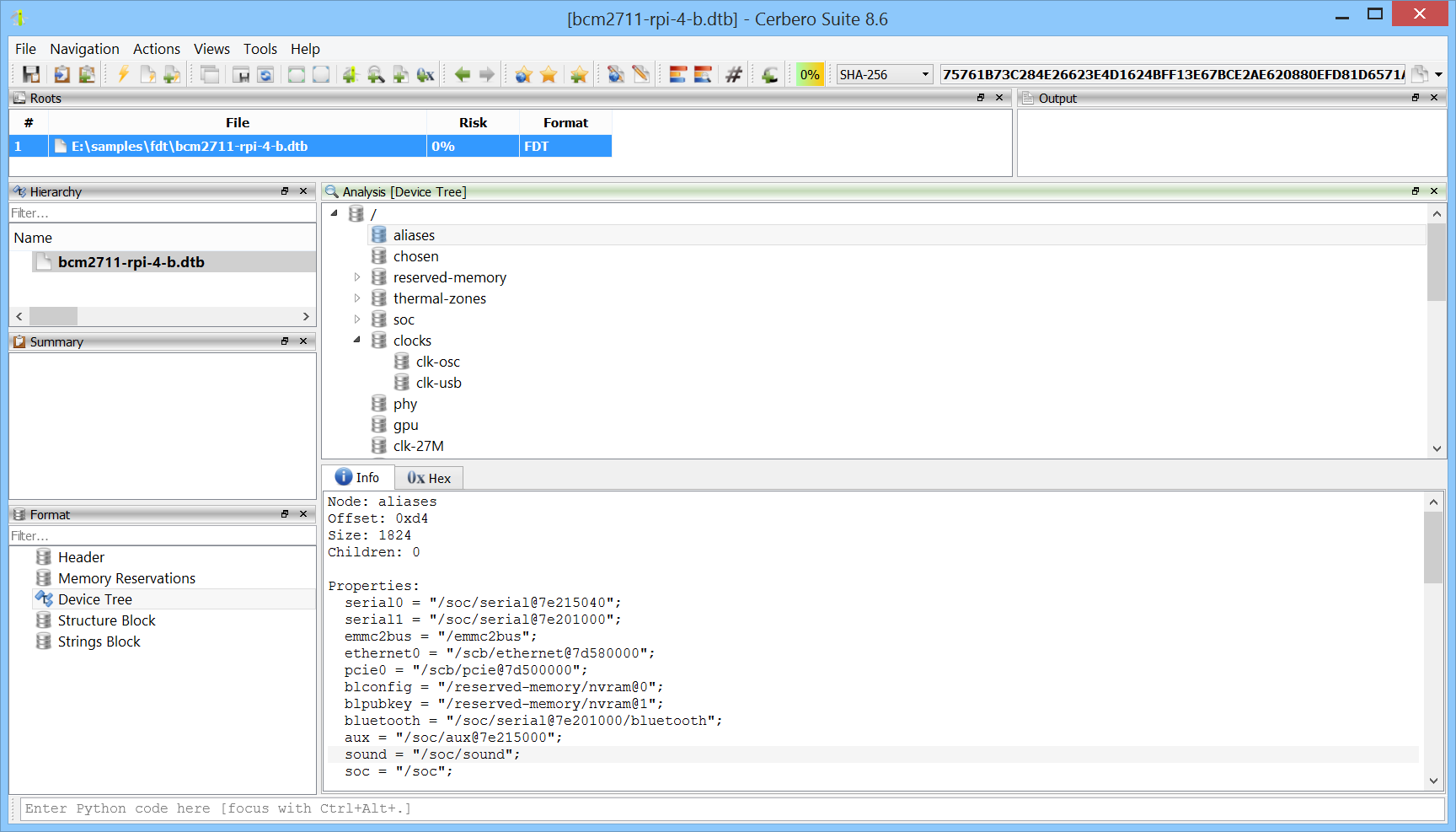
FDT is the binary format that bootloaders hand to the Linux kernel (and other operating systems) to describe non-discoverable hardware on ARM, ARM64, RISC-V, PowerPC and similar platforms. A DTB encodes the entire hardware topology of a board: CPUs and their cache hierarchy, physical memory regions, on-chip peripherals like UARTs, I²C and SPI controllers, GPIO banks, USB hosts, MMC/SD, Ethernet MACs and GPUs, interrupt routing, clock and power domains, kernel boot arguments and reserved memory regions. The same blob is used as device tree overlays (.dtbo) to patch a base tree at boot for HATs, capes and optional peripherals. DTBs are routinely pulled from boot partitions, firmware images and recovery dumps during security research, IoT analysis and forensic investigations. Having native FDT support in Cerbero Suite means analysts can read out a device’s hardware description — the same information the OS uses to bring the system up — without leaving the analysis environment.